
We are the ones we’ve been waiting for
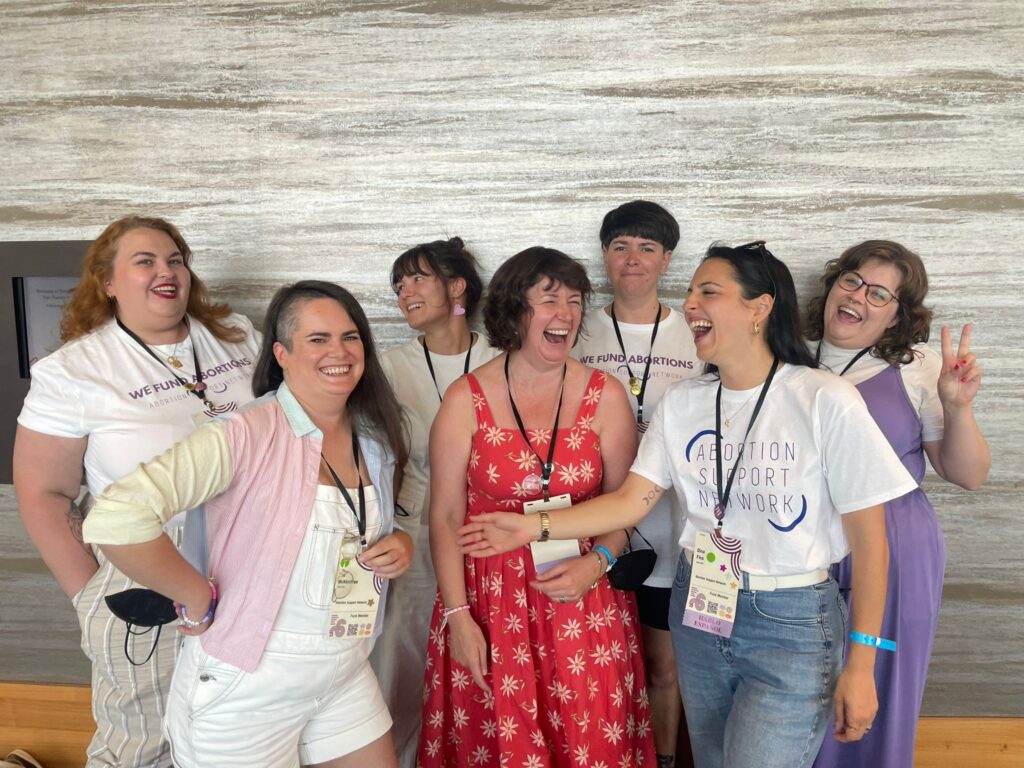
In August last year, a small team from ASN was invited (and subsidised) to attend the National Network of Abortion Funds 2025 summit in Colorado. This is a gathering of abortion funds, primarily from the US but attended by a handful of funds from outside of the US – including our partners Fondo Maria from Mexico, fellow Abortion Without Borders members Women Help Women, and ASN staff and helpline volunteers. Our Digital Projects Officer, Abbie, was one of those who attended the summit.
Fresh from a midwinter break and with renewed energy for the new year, I find myself reflecting on the NNAF conference in August.
What remains from the summit – as well as the multitude of ways the learning has shaped my work and thinking – is a mixture of gratitude and grief.
Gratitude for such an incredible opportunity, to be ‘let into’ the world of the US abortion movement, and to see the sheer scale of people mobilising. I met activists and healthcare professionals, young people and old, from a vicar running an in-church abortion fund to people working in Appalachia to help people access abortion in the most remote of places.
Gratitude for being welcomed into a space that so firmly held abolitionist and care-centred values at its core. Gratitude for the being able to see that ASN are a part of that world and that work.
And there is grief, too, at returning to a rural home and remote work, and feeling some of that sense of connection to a ‘wider movement’ fade away. I feel a need to make sure we keep building on the incredible networks we are part of in Europe, to make sure we sustain the same thing on this side of the Atlantic.
Because we are going to have to. In the US, the attack on abortion rights is so current and visceral that there is a whole movement built around the response to this. Everyone can see the need, and people feel compelled to be a part of the fight for reproductive justice.
I can sometimes feel that people in the UK think abortion restrictions are a ‘them’ problem (‘them’ being people in the US, but not here in Europe). But it is most certainly an ‘us’ problem too – ASN’s and AWB’s work is a testament to that. For abortion seekers in Poland, France, Ireland, Hungary, Romania, Malta and more – the problem is already at their doors.
We know, too, that sinister movements are working to bring us in line with the US landscape here in the UK.
Reproductive justice and bodily autonomy are loaded topics, and extremely vulnerable to moral panic. We see this in the vilification of trans people in the UK and the restriction of their access to healthcare, in abortion bans and restrictions, and in the way that abortion care is seen as something separate to all other forms of healthcare. They are used as wedge issues, to fracture feminist movements, spark infighting and diffuse the power of collective organising. I usually object to ‘it’ll be you next’ rhetoric, because I think we should care about other humans even if it won’t be ‘us next’, but in this case it is starkly clear that it will be abortion rights next.
But how do you build a movement like this?
The work of funding abortions is just one small part of the scope of the abortion activist community – visible in microcosm at the summit.
In amongst the informative panels, workshops and learning spaces were childcare spaces, wellbeing spaces, a restful hub with herbal tea and tarot, a karaoke session and a bracelet-making session punctuated one of the evenings. A chorus formed at the start of the summit and spent the time building and rehearsing to lead at the closing ceremony. The movement swirls around the work at its core – but the joy and friendship and care and connection are just as important.
And in the context of the US abortion landscape – this care is vital to ensure the work can keep being done. The risks of volunteering for abortion funds are tangible, people are scared and tired and burned out. But they make space for this and move through it, they care for one another, they sing together. ‘Abortion is an act of love.’
Resist, reimagine, rebuild.
When building a movement we must remember how the best work is done: as a movement towards liberation. We may be picturing losing some of the freedoms we take joy from, but in our resistance to that we should be driven by the freedoms we want back and live them anyway. The joy in the movement comes not from the fight, but from imagining the world we are building.
Since we came home a refrain has echoed in my head, sung in chorus at the end of the summit: ‘we are the ones we’ve been waiting for.’
In the UK, in Europe, just like in the US – we can’t wait. We can’t wait for the sector institutions or politicians to make a move on reproductive justice when it’s already too late. We can’t wait for the system to care about us – we must care for each other. Nobody is coming to save us – we are the ones we’ve been waiting for.